
Introduction
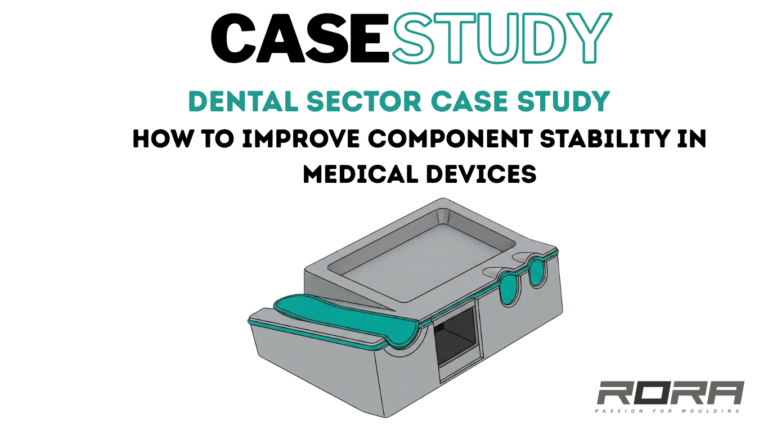
In the medical and dental sectors, mechanical reliability and regulatory compliance are critical factors. When a leading dental equipment company approached us to develop a support gasket (“cradle”), the goal was clear: to create a versatile support component capable of ensuring stability both when installed on the main device and when placed on various surfaces, such as a workbench.
The Initial Challenge: Weight and Deformation
The initial project, based on a reference mathematical model draft provided by the client, presented a fundamental issue: the component was unable to support the weight of the handpiece and equipment without undergoing deformation over time. The absence of stiffening elements led to structural sag during prolonged use.
The Engineering Solution: Wall Thickness and Structural Ribs
Following a thorough analysis of the functional requirements, our R&D team redesigned the part’s CAD geometry by introducing two key improvements:
- Increased wall thickness at points of highest mechanical stress.
- Integration of structural support ribs, engineered to evenly distribute the load of the handpiece and maintain the original geometry without compromising usability or flexibility.
Regulatory Compliance and Custom RAL Color
In addition to mechanical aspects, the development satisfied the strict aesthetic and regulatory standards of the medical sector. The polymer and coloring selection met all restrictions for medical devices, guaranteeing a uniform finish compliant with a specific RAL shade indicated by the client.
Prototyping, Tooling, and Results
Once the new CAD geometry was validated, dedicated tooling was manufactured to produce the initial prototypes. Subsequent prototyping and testing phases confirmed full compliance with load and stability requirements, giving the green light for series production.