Anyone looking to start production of a rubber component almost always faces the same question: is injection molding or compression molding better? There is no one-size-fits-all answer. The right choice depends on three intertwined factors: production volume, compound cost, and part complexity. Let’s look at how to navigate these options.
Two Different Filling Logics
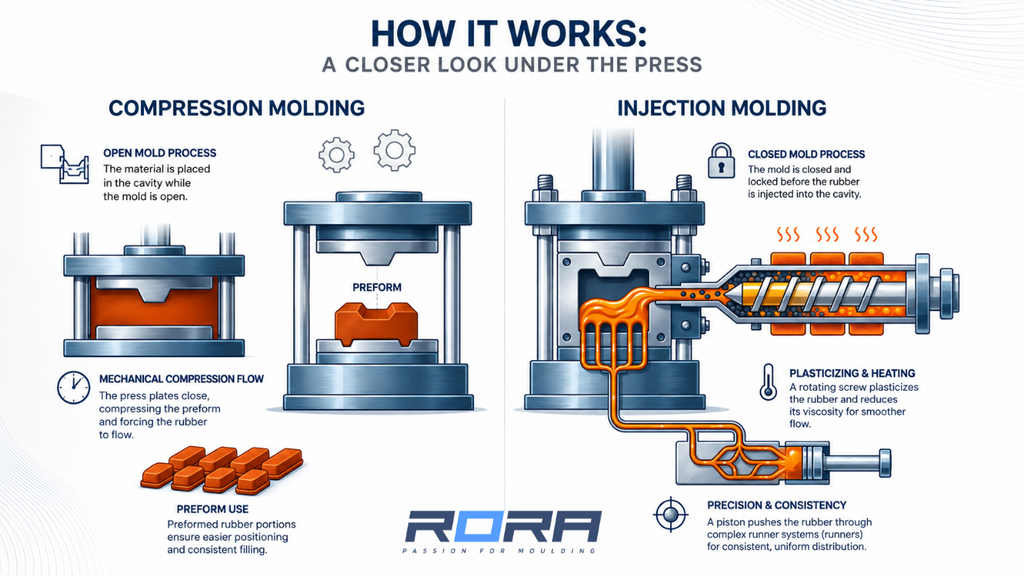
In compression molding, the mold parting line is open when the rubber preform is placed directly into the cavity. Only then does the press ram apply clamping pressure, forcing the rubber to flow and fill the mold via backpressure. Conceptually, it is the simpler of the two processes and also generates the least engineered waste overall, as there are no runner systems to fill.
In injection molding, the sequence is reversed: the parting line is closed and brought to clamping pressure before the rubber enters the cavity. A strip preform is metered through a screw, pushed into a ram chamber via a three-way valve, and injected from there—through the nozzle, sprue, and runner channels—into the already sealed cavity. This “close-before-fill” sequence is what makes injection so repeatable and easy to automate.
Production Volumes and Cycle Times
This is where the difference is most distinct. Injection offers the shortest cure times among all molding processes, significantly more efficient temperature and pressure control, and—above all—a level of automation that allows a single operator to oversee multiple presses simultaneously. Compression, by contrast, almost always requires a dedicated operator per machine, longer cure cycles, and larger molds for the same number of parts produced.
For this reason, the rule of thumb is simple: high volumes and fast cycle times push toward injection, while lower volumes make it difficult to amortize the larger mold and machine investment that injection requires.
The Case of Expensive Compounds
There is, however, an important exception worth lingering on: high-cost compounds, such as FFKMs, which can cost several thousand dollars per kilogram. In these cases, the volume criterion takes a backseat to waste reduction.
By its nature, injection produces the highest volume of engineered waste in absolute terms among the three main processes: runners, sprues, and parting line flash can amount to two to four times the volume of the finished part. The runner is usually the largest source of waste, even more than the flash itself. Compression, having no runner channels to feed, remains the process that wastes the least material overall.
When the compound cost is so high that any avoidable scrap is unsustainable, compression—despite longer cycle times—often becomes the most economically sensible choice, even at the expense of hourly productivity.
Mold Cost and Complexity
The two processes also sit at opposite ends of the spectrum on this front. A compression mold is the least expensive and least complex to manufacture among the main processes, featuring shorter lead times. An injection mold, needing to manage distribution runners, calibrated tear trims, and often cold runner systems to limit waste, is the most expensive and complex, with longer lead times.
The same applies to the press: a compression machine is mechanically simpler, while an injection press requires dosing systems, multi-zone thermal control, and dedicated automation.
Part Complexity
A final criterion, often underestimated during the quoting phase, is the geometric complexity of the component. Compression works well on relatively simple geometries where the rubber travels short distances to fill the cavity: the more intricate the part, the higher the risk of visible weld lines or incomplete filling, as the preform is not yet under pressure when it begins to flow.
Injection, entering an already pressurized cavity at high speed through custom-sized gates, handles complex geometries, thin walls, and multi-cavity configurations far better where fill balance is critical. It is no coincidence that the most intricate technical components—diaphragms, bellows, connectors with inserts—are almost always directed toward injection molding, regardless of volume.
Summary Table
| Criterion | Compression | Injection |
| Ideal production volumes | Low / Medium | Medium / High |
| Cycle time | Longer | Shorter |
| Absolute engineered waste | Minimal | Up to 2–4x part volume |
| Mold cost and complexity | Low | High |
| Automation | Limited | High |
| Suitable for very expensive compounds (e.g., FFKM) | Yes | Generally no |
The Right Choice for Your Project
If your project involves medium-to-high volumes with a standard-cost compound, injection molding pays off the initial investment with fast cycles and low direct labor. If you are working with a particularly expensive compound or the volumes do not justify a complex mold, compression molding often remains the most solid choice.
In many real-world scenarios, the decision is rarely “all or nothing”: it can also make sense to evaluate transfer molding or hybrid transfer molding as middle-ground alternatives, a topic we will explore in an upcoming article.