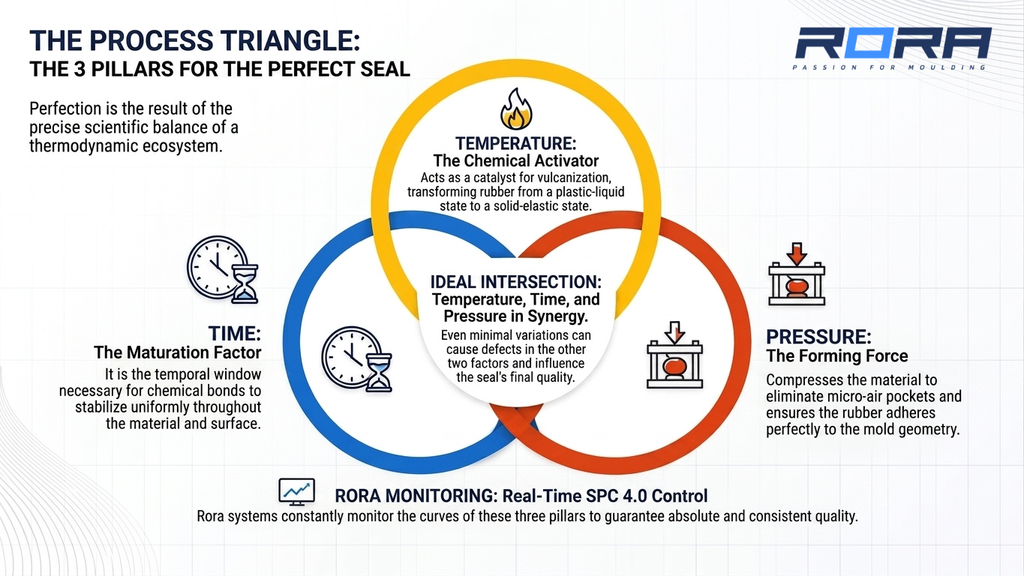
Anyone working with rubber molding on a daily basis knows all too well the frustration of a parameter that looks correct on paper, yet continuously generates scrap in production. Often, the root cause is not a single wrong parameter, but an imbalance among three variables that can never be considered in isolation: time, temperature, and pressure.
Three Variables, a Single Decision
Time, temperature, and pressure are not three independent levers to be adjusted one by one without consequences on the others. They are co-dependent elements: altering one almost always means modifying the effect of the other two. Increasing the temperature accelerates vulcanization, but it can also reduce the usable time for the rubber to flow and fill the cavity properly before the cross-linking process stops the flow. Raising the pressure can improve cavity filling, but if the temperature is inconsistent, it risks causing a different defect—perhaps seemingly opposite to the first one.
This is why the “Triangle”—three elements sharing the same level of authority over the final result—is the most useful mental model for tackling any process variation: none of the three parameters can be optimized “in a vacuum,” ignoring the other two.
Why a Small Variation Has a Disproportionate Effect
The very nature of rubber prior to vulcanization helps explain why the system is so sensitive. The uncured compound behaves like a set of long polymer chains tangled together, but not yet chemically bonded. In other words, it behaves more like a liquid than a solid, which is precisely why it can be poured and take on the shape of the mold cavity.
By applying heat and vulcanizing agents over time, bonds—cross-links—gradually form at the points where the chains intersect. It is not that an individual chain becomes longer; rather, the entire network of chains, now bonded at thousands of points, can no longer be disentangled. It is at this exact moment that the rubber stops behaving like a liquid and begins to retain the shape of the mold even after ejection.
This transition is governed precisely by the three parameters of the Triangle: temperature provides the energy required to trigger the reaction, time determines how many cross-links manage to form, and pressure ensures that the rubber remains in contact with the cavity walls throughout the entire process. Even a small variation in one of these three variables shifts the equilibrium point of the entire system—hence the often disproportionate effect observed on the shop floor.
The Correct Method for Intervention: One Variable at a Time
Precisely because these three parameters are so interconnected, the most important practical rule when troubleshooting a process issue is to change only one variable at a time, measuring the effect before moving on to the next. Changing two or three parameters simultaneously makes it nearly impossible to understand which action actually solved—or exacerbated—the problem.
However, not all three variables are equally easy to control and monitor:
- Time is the simplest parameter to modify and verify: it is a direct, immediate value to measure, and is generally the first one to be adjusted.
- Pressure is more complex, because its actual distribution inside the mold is not directly visible—pressure-sensitive films are required to truly map how it distributes across the cavity surface.
- Temperature is the most delicate variable: thermocouples only measure discrete points, not the entire thermal distribution, and the system can take anywhere from a few minutes to an hour to reach a new thermal equilibrium after a change. For this reason, adjusting temperature parameters should remain under the supervision of an experienced process technician, whereas time and pressure can be delegated more freely to line operators.
An effective approach to identifying the boundaries of a parameter, such as cure time, is to test extreme conditions—half and double the current value—instead of making micro-adjustments: the cause-and-effect relationship becomes much clearer, allowing you to progressively narrow the range down to the optimal value.
A Practical Example
Consider a batch of seals that begins showing surface bubbles following a compound change. The immediate temptation is often to raise both temperature and pressure together, hoping to “force” better filling. However, if the bubbles stem from insufficient dwell time before enough cross-links form—a time-related issue rather than a pressure-related one—this double intervention risks temporarily masking the original defect while introducing a new one, such as distortion caused by excessive pressure.
The correct approach would be to isolate the cure time first, test it at the extremes as described above, observe the effect on the bubbles, and only then—if necessary—adjust a second parameter. While this process is slower in the short term, it is the only way to build a true understanding of cause and effect instead of accumulating disconnected tweaks that will inevitably resurface in another form later.
A Model, Not a Formula
The Process Triangle does not provide out-of-the-box numbers: it is a conceptual framework. Whenever a parameter is called into question—whether during the startup of a new production run or during troubleshooting—it is worth asking not just “is this value correct?”, but also “what happens to the other two points of the triangle if I change it?”. It is precisely within that question that you will often find the fastest path to a seal molded correctly on the first attempt.